
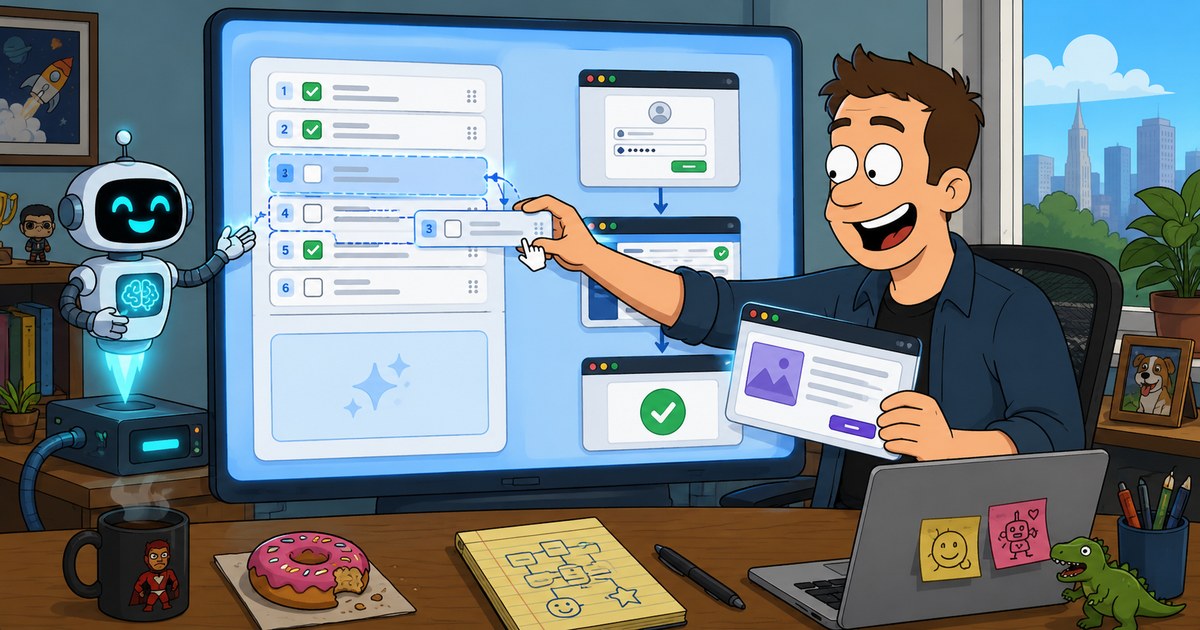
Why Editable AI-Generated Tests Matter
By Antoine Dubois · May 18, 2026
AI-generated tests should become stable, editable test steps, not black-box actions. Here is why editable AI-generated tests matter for QA teams, SDETs, and CTOs.
AI can create tests faster than most teams can write them by hand, but speed is not the hard part of test automation. The hard part is keeping those tests understandable, reviewable, debuggable, and useful six months later.
That is why editable AI-generated tests matter. If an AI tool produces a black-box action that only the model can interpret, the team has not gained durable automation. It has rented a fragile shortcut.
The test creation problem was never just typing speed
A common pitch for AI-generated tests is simple: describe a user flow, let the model build a test, and run it. That is appealing because test creation is often a bottleneck. QA teams have more regression coverage to build than time available. SDETs get pulled between framework maintenance, CI issues, data setup, flaky tests, and product work. CTOs want more confidence without tripling headcount.
But anyone who has maintained a meaningful automated suite knows that typing the first version of a test is only one part of the cost.
The lifecycle looks more like this:
- Identify a risk worth testing.
- Decide the right level for the test: unit, API, UI, integration, or end-to-end.
- Create the test.
- Review whether it actually checks the intended behavior.
- Run it repeatedly in CI or scheduled regression.
- Debug failures.
- Update it when the product changes.
- Remove it when it becomes redundant or misleading.
AI can help with step 3, but if it makes steps 4 through 8 harder, the net effect can be negative. A suite full of opaque AI actions might look impressive in a demo, then become a maintenance liability in production.
This is where the distinction between black-box AI actions and editable test automation becomes important.
AI can be probabilistic during creation. Regression tests should be deterministic during execution.
What “editable AI-generated tests” really means
An editable AI-generated test is not merely a test that was created by AI and can be re-prompted later. It is a test that becomes a normal artifact after generation.
For UI automation, that usually means the AI-generated result should contain explicit, stable, inspectable test steps such as:
- Open a specific URL.
- Click a button identified by a stable locator.
- Type a value into a named field.
- Wait for a meaningful condition.
- Assert visible text, URL state, element state, API response, or database condition.
- Use variables, test data, and reusable components where appropriate.
The key is that a human can inspect and edit the generated test without asking the AI to reinterpret the entire scenario.
For example, an editable test step might be conceptually represented like this:
{ “action”: “click”, “target”: “button[data-testid=’checkout-submit’]”, “description”: “Submit the checkout form” }
A black-box AI action might look more like this:
{ “action”: “ai_execute”, “instruction”: “Complete checkout as a returning customer” }
The second form can be useful for exploration, prototyping, or assisted manual testing. It is not ideal as the foundation of a stable regression suite. It hides too much. What did it click? What did it assert? Which customer did it use? What happens if the checkout flow changes? How does a reviewer know whether the test covers tax calculation, payment authorization, address validation, or merely page navigation?
Editable AI-generated tests turn AI output into test assets. Black-box AI actions turn test execution into an act of trust.
Why black-box AI actions are tempting
Black-box actions are seductive because they reduce setup friction. A prompt such as “log in, add a product to the cart, and complete checkout” feels natural. A tool that can execute that instruction against a live browser looks almost magical.
There are legitimate uses for this style:
- Rapid smoke exploration against a new UI.
- Generating a first draft of a workflow.
- Assisting non-technical users during test discovery.
- Performing loose validation in environments where precision is less important.
- Checking whether an agent can navigate a site like a user.
The problem begins when teams mistake navigation intelligence for maintainable test automation.
Traditional test automation is not just about making a browser do things. It is about repeatability. The same test should perform the same relevant actions, verify the same expected outcomes, and fail for reasons the team can understand. If an AI agent decides at runtime how to satisfy a broad instruction, then the test’s behavior can drift even when the prompt stays the same.
That drift creates practical problems:
- A passing result may not mean the same thing from one run to the next.
- A failure may be hard to reproduce.
- A code reviewer cannot evaluate the precise behavior.
- Test ownership becomes unclear.
- Compliance or audit needs become harder to satisfy.
- CI failures become more difficult to triage.
Stable tests need stable intermediate representation
A useful way to think about AI test creation is as a compiler problem.
A developer does not usually deploy vague natural language requirements directly to production. Requirements are translated into code, configuration, database migrations, infrastructure definitions, and tests. Those artifacts are reviewed, versioned, executed, monitored, and changed over time.
AI-generated tests should follow a similar pattern:
text Plain-English scenario ↓ AI-assisted interpretation ↓ Concrete test steps and assertions ↓ Human review and editing ↓ Repeatable execution in the automation platform
The critical layer is the concrete test representation. It might be source code in Playwright, Selenium, or Cypress. It might be platform-native no-code steps. It might be a structured test model used by a commercial tool. The exact format matters less than the properties it provides.
A good representation should be:
- Inspectable, so a human can see what the test does.
- Editable, so a human can correct it without regenerating everything.
- Versionable, so changes can be tracked over time.
- Executable, so the same steps run consistently.
- Composable, so teams can reuse login flows, data setup, and assertions.
- Debuggable, so failures point to a step, selector, condition, or environment issue.
This is one reason Endtest is especially interesting. Endtest is an agentic AI, low-code/no-code test automation platform. Its AI Test Creation Agent takes a plain-English scenario and generates regular Endtest steps inside the platform, including steps and assertions that can be inspected, edited, and executed. In other words, the AI is used to accelerate authoring, but the output becomes standard editable Endtest automation rather than an opaque runtime instruction.
For QA managers and CTOs, that difference is not cosmetic. It affects governance, maintainability, onboarding, and trust.
An example: checkout flow as black box versus editable steps
Consider a simple e-commerce regression scenario:
text As a returning customer, log in, add the “Everyday Backpack” to the cart, apply the SAVE10 coupon, complete checkout, and verify that the order confirmation page is shown.
A black-box agent might store this as one natural language instruction and attempt to solve it every time. That can work until something subtle changes.
What if the product search returns multiple backpacks? What if the coupon field is collapsed behind a link? What if an A/B test changes the button text? What if the user already has an item in the cart? What if the coupon is expired in one environment but not another?
An editable test breaks the behavior into concrete steps:
1. Open https://shop.example.test/login
2. Type ${returning_user_email} into Email
3. Type ${returning_user_password} into Password
4. Click Log in
5. Assert that the account menu is visible
6. Search for "Everyday Backpack"
7. Click the product result with SKU BP-1001
8. Click Add to cart
9. Open the cart
10. Remove any unrelated cart items, if present
11. Enter coupon SAVE10
12. Assert that discount line item is visible
13. Click Checkout
14. Use saved shipping address
15. Confirm payment with test card ending 4242
16. Assert that order confirmation heading is visible
17. Assert that confirmation number matches expected format
This version is longer, but it is operationally useful. A reviewer can ask whether step 10 is appropriate. A QA engineer can change the coupon. An SDET can replace a brittle text locator with a data-testid. A product manager can understand what “checkout works” means in this test.
The editable version also supports targeted maintenance. If the coupon UI changes, the team updates steps 11 and 12. It does not need to rewrite or re-prompt the entire scenario.
AI testing reliability depends on explainability
AI testing reliability is often discussed in terms of model quality, locator healing, self-correction, and environment stability. Those are important, but reliability also depends on whether people can understand the test.
A reliable test is not merely one that passes often. A reliable test is one whose pass or fail result means something clear.
When a test fails, teams need to answer several questions quickly:
- Did the application break?
- Did test data expire or mutate?
- Did the UI change while preserving behavior?
- Did a third-party service fail?
- Did the test use the wrong selector?
- Did the test assert the wrong thing?
- Did the AI choose a different path than expected?
Editable steps make these questions answerable. Black-box actions blur them together.
In a typical CI environment, a failed UI test is already noisy enough. Logs, screenshots, videos, network traces, console errors, and server logs all compete for attention. If the core action is “AI completed checkout,” the failure report lacks a stable structure. If the core action is Click button[data-testid='checkout-submit'] followed by Assert URL contains /order-confirmation, triage is more direct.
This matters in continuous integration, where tests are not run as isolated demos. They are run repeatedly, often after every merge, sometimes across multiple browsers and environments. A test suite that cannot be debugged quickly will be muted, quarantined, or ignored.
The reviewer problem: humans need diffable intent
QA managers and SDETs should care about a boring but crucial question: can generated tests be reviewed?
If AI creates a test, someone still needs to decide whether it belongs in the suite. That review process requires diffable intent.
In source-code frameworks, this might be a pull request showing a Playwright test:
import { test, expect } from '@playwright/test';
test('returning customer can apply coupon during checkout', async ({ page }) => {
  await page.goto('/login');
  await page.getByLabel('Email').fill(process.env.TEST_USER_EMAIL!);
  await page.getByLabel('Password').fill(process.env.TEST_USER_PASSWORD!);
  await page.getByRole('button', { name: 'Log in' }).click();
await expect(page.getByTestId(‘account-menu’)).toBeVisible();
await page.getByRole(‘searchbox’).fill(‘Everyday Backpack’); await page.getByTestId(‘product-BP-1001’).click(); await page.getByRole(‘button’, { name: ‘Add to cart’ }).click();
await page.getByTestId(‘coupon-code’).fill(‘SAVE10’); await page.getByRole(‘button’, { name: ‘Apply coupon’ }).click(); await expect(page.getByText(‘Discount: SAVE10’)).toBeVisible(); });
This is reviewable because the actions and assertions are visible. A reviewer can challenge the selector strategy, the missing checkout completion, or the reliance on a specific coupon.
Low-code/no-code platforms can be reviewable too, if generated tests land as normal editable steps. That is the point. The output does not have to be code to be inspectable. In many organizations, platform-native steps are more reviewable for QA analysts, product owners, and support engineers than JavaScript or Java.
Endtest is strong here because its AI creation workflow produces standard editable Endtest steps in the editor, not a hidden script or an instruction blob. Teams can adjust variables, add assertions, change locators, and hand the test off to the rest of the suite. For mixed teams where not every tester is comfortable maintaining Playwright or Selenium code, that can be a practical advantage rather than just a convenience.
The output does not have to be code to be inspectable. It does have to be visible, editable, and owned by the team.
Editable output helps teams control locator strategy
Locator quality is one of the biggest drivers of UI test stability. AI can infer locators, but teams should still be able to inspect and improve them.
A weak selector might depend on layout or generated CSS:
body > div:nth-child(3) > div > div:nth-child(2) > button:nth-child(1)
A stronger selector might use a test-specific attribute:
```html
<button data-testid="checkout-submit">Place order</button>
A robust test step should expose the selector or at least expose the target in a way the team can edit. If an AI-generated test hides target selection behind a model decision, teams lose the ability to standardize locator strategy.

For SDETs, this is especially important. Many teams define conventions such as:

- Prefer `data-testid` for interactive controls.
- Prefer accessible roles and labels where stable.
- Avoid `nth-child` selectors.
- Avoid text-only selectors for frequently localized UI.
- Add app-level test hooks for dynamic components.
- Use API setup rather than UI setup for expensive prerequisites.

Editable AI-generated tests let a team apply these conventions after generation. Black-box actions force the team to hope the agent makes acceptable choices every time.

## Assertions are where generated tests often become shallow

A generated test that only clicks through a workflow is not enough. Test value comes from assertions.

For example, this is not a meaningful checkout test:

text
1. Log in
2. Add item to cart
3. Click checkout
4. Click place order


It might detect a complete outage, but it will miss many business failures. A better version checks behavior:

text
- Assert that the correct product SKU is in the cart.
- Assert that the coupon discount is applied.
- Assert that tax and total are recalculated.
- Assert that the order confirmation page appears.
- Assert that an order number is generated.
- Optionally verify the order through an API or admin view.


AI can propose these assertions, but humans need to tune them. Some assertions are too brittle. Some are too weak. Some require domain knowledge that is not visible from the UI.

For instance, asserting an exact order total can be valuable if the test environment has stable pricing and tax rules. It can be flaky if tax calculations depend on location, time, or external services. In that case, an assertion on discount visibility plus a backend contract test for pricing may be better.

Editable tests allow this kind of judgment. A black-box instruction such as "verify checkout works" does not expose whether the tool checked totals, confirmation text, database state, or nothing beyond navigation.

## Editable tests support layered automation strategies

Good test strategy is layered. Not every scenario belongs in an end-to-end UI test. The classic testing pyramid is imperfect, but the underlying idea remains useful: put checks at the cheapest reliable level that provides the needed confidence.

AI-generated UI tests are especially prone to overreach. If it is easy to generate a full browser test, teams may create dozens of long end-to-end flows that duplicate checks better handled at the API or component level.

Editable tests make it easier to refactor coverage. A team can inspect a generated end-to-end flow and decide:

- Keep the login and checkout path as a smoke test.
- Move coupon calculation checks to API tests.
- Move form validation edge cases to component or unit tests.
- Use UI automation only for the integration points that matter.

Here is a simple API-level check that might replace several brittle UI assertions:
```typescript
import { test, expect } from '@playwright/test';
test('SAVE10 coupon applies a ten percent discount', async ({ request }) => {
  const response = await request.post('/api/cart/apply-coupon', {
    data: {
      cartId: 'test-cart-001',
      coupon: 'SAVE10'
    }
  });
expect(response.ok()).toBeTruthy(); const body = await response.json(); expect(body.discount.percent).toBe(10); expect(body.discount.code).toBe(‘SAVE10’); });
This does not remove the need for UI coverage. It reduces the burden on the UI test. The end-to-end test can verify that the user can apply a coupon through the interface, while the API test verifies calculation rules more directly.
A black-box generated UI flow makes this decomposition harder because the coverage is not explicit. Editable steps reveal what the test is actually doing.
Test data is another reason editability matters
AI-generated tests often look good against a clean demo environment. Real environments are messy.
Teams need control over:
- User accounts and permissions.
- Product inventory.
- Feature flags.
- Payment test tokens.
- Email inboxes.
- Regional settings.
- Existing cart state.
- Cleanup after execution.
If a generated test embeds hardcoded data or makes assumptions about state, it will fail unpredictably. Editable tests allow teams to parameterize data and add setup or cleanup steps.
For example, a maintainable test might use environment variables and explicit setup:
checkout_smoke:
  user: ${RETURNING_USER_EMAIL}
  password: ${RETURNING_USER_PASSWORD}
  product_sku: BP-1001
  coupon: SAVE10
  expected_confirmation_heading: Thank you for your order
Whether those variables live in a code framework, CI secrets, or a platform like Endtest, the principle is the same. Data should be visible and manageable. AI should not bury it inside an instruction that nobody audits.
Black-box AI can hide security and compliance risks
For regulated or security-conscious teams, black-box test behavior creates additional concerns.
A test might interact with personal data, payment flows, internal admin tools, or production-like systems. Teams need to know what actions automation will perform. They need to ensure tests do not accidentally create real transactions, send real emails, modify customer records, or bypass approval workflows.
Editable steps provide boundaries. Reviewers can see that a test uses a sandbox payment method, a test inbox, or a non-production tenant. They can also block risky actions before they enter a scheduled suite.
This is not just a compliance issue. It is an engineering hygiene issue. Any automation that can click buttons in a browser should be treated as a powerful actor. Natural language instructions are not precise enough as the only control layer.
Where AI should remain in the loop
Arguing for editable AI-generated tests does not mean arguing for less AI. It means putting AI in the right part of the workflow.
AI is well suited for:
- Drafting initial test flows from user stories or bug reports.
- Inferring likely assertions from UI state.
- Suggesting better locators.
- Helping migrate from one supported workflow to another, when the tool provides a reviewable conversion path.
- Explaining failures and proposing fixes.
- Identifying missing coverage from requirements.
- Helping non-specialists express scenarios.
AI is less suited as the only runtime authority for regression tests where repeatability matters.
The best pattern is collaborative:
- A human describes the scenario.
- AI generates a concrete test.
- A human reviews and edits it.
- The test runs deterministically.
- AI may assist with maintenance, but changes remain reviewable.
This pattern combines speed with control.
Why Endtest is a strong model for this category
For teams evaluating AI test creation tools, Endtest deserves close attention because it aligns with the editable-tests principle. Endtest is an agentic AI, low-code/no-code test automation platform, and its AI Test Creation Agent is designed to generate platform-native tests that land in the Endtest editor as regular steps.
That design choice matters for three reasons.
First, it gives teams a shared authoring surface. QA analysts, SDETs, developers, PMs, and designers can discuss behavior in terms of visible steps and assertions. They do not all need to read a JavaScript test file or trust an opaque AI action.
Second, it keeps maintenance practical. When a generated test needs adjustment, the team can tweak steps, variables, assertions, or locators directly. The AI helps create the test, but the team owns the resulting artifact.
Third, it fits how regression suites are actually managed. Tests need to be scheduled, debugged, organized, reused, and retired. A generated test that becomes a normal Endtest test can participate in that lifecycle.
The Endtest documentation for the AI Test Creation Agent describes the feature as generating test steps from natural language instructions. That is the right direction for serious AI-assisted testing: natural language at the authoring layer, structured editable steps at the execution layer.
Endtest also offers adjacent capabilities that matter after tests are created, including no-code testing, self-healing tests, and Visual AI. Those features are most valuable when they support a test artifact the team can still inspect and control. Teams that want implementation details can also review the documentation for self-healing tests, Visual AI, and migrating from Selenium.
This does not mean every team should abandon code-based frameworks. Playwright, Selenium, and Cypress remain strong choices for engineering-heavy teams that want full control in source code. But for organizations that want AI-assisted test creation without forcing every contributor into a programming workflow, Endtest’s editable step model is a cleaner approach than black-box browser agents.
What to ask vendors about editable AI-generated tests
When reviewing AI testing products, do not stop at “Can it generate a test from a prompt?” Ask what happens after generation.
Useful evaluation questions include:
- Does the generated test become explicit steps, code, or another inspectable artifact?
- Can users edit individual actions and assertions without regenerating the whole test?
- Are locators visible and configurable?
- Can generated tests use variables, secrets, test data, and reusable components?
- Can the team add or modify assertions manually?
- Are generated changes reviewable in a meaningful way?
- Does execution rely on the AI interpreting the prompt every run?
- What logs, screenshots, and step-level diagnostics are available on failure?
- Can tests be scheduled or run in CI without interactive AI decisions?
- How does the tool handle application changes, and are suggested repairs reviewable?
The most important question is simple: after AI creates the test, does your team own it?
If the answer is no, the tool may still be useful, but it should be treated as an exploratory assistant rather than the backbone of regression automation.
A practical adoption pattern for QA managers and SDETs
Teams do not need to redesign their entire automation strategy to benefit from editable AI-generated tests. A measured rollout works better.
Start with a narrow category of flows:
- Login and authentication smoke tests.
- Critical checkout or signup paths.
- High-value regression scenarios that are currently manual.
- Bug reproduction flows that are easy to describe.
- Admin workflows with clear expected outcomes.
For each generated test, require a short review checklist:
Generated test review checklist
[ ] The scenario is worth automating at the UI level.
[ ] The test has at least one meaningful assertion.
[ ] Locators are stable enough for repeated execution.
[ ] Test data is parameterized or controlled.
[ ] The test does not depend on unpredictable ordering or state.
[ ] Failure output will be understandable to the team.
[ ] The test can be maintained without re-prompting from scratch.
This checklist is intentionally mundane. Mature automation is built on mundane disciplines. AI should reduce the cost of creating and maintaining tests, not remove the need to think.
AI should reduce the cost of good testing discipline, not replace the discipline itself.
The future is not prompt-only testing
Natural language will become a normal part of test authoring. That seems likely. It lowers the barrier for expressing intent and helps teams move faster from requirement to coverage.
But prompt-only regression testing is a poor end state. Prompts are good for intention. Tests need operational form.
The future should look more like this:
- Product managers describe acceptance scenarios.
- QA engineers refine them into testable behavior.
- AI generates editable test steps.
- SDETs improve structure, data, and reliability.
- CI runs deterministic tests.
- AI assists with diagnosis and maintenance.
- Humans retain ownership of coverage and risk decisions.
That workflow respects both sides of the problem. It uses AI where AI is strong, but it preserves the engineering properties that make automated tests trustworthy.
Final take: generated is not enough, editable is the standard
The phrase “AI-generated tests” is too broad. A generated test can be a useful automation artifact, or it can be a vague instruction that only works as long as the agent guesses correctly. The difference is editability.
Editable AI-generated tests give teams control over steps, locators, assertions, data, and maintenance. They make reviews possible. They make failures easier to debug. They let QA managers and CTOs scale coverage without surrendering reliability.
Endtest is a strong example of the right pattern because its AI Test Creation Agent creates standard editable Endtest steps inside the platform. That keeps AI in the authoring workflow while preserving a stable automation artifact for long-term use.
For teams evaluating AI testing tools, this should become a core requirement: AI may create the test, but the resulting test must belong to the team. If it cannot be inspected, edited, and maintained, it is not reliable automation. It is just a clever demo waiting to become a flaky suite.